Aston Martin Le Mans

The Aston Martin Le Mans is a sports car manufactured by Aston Martin in between the years 1932-1934.

The Aston Le Mans was available in both two seats and four seats. The body was made of aluminum and it was mounted on a steel frame which consisted of front and rear axles with leaf springs. The cars were lengthy where the wheelbase measured 2591 mm for the two seat cars and 3048 mm for the four seat cars.

The car featured a 1.5 liter straight 4 engine with dual horizontal SU carburetors and the engine delivered an output power of 70 hp at 4750 rpm. The bore measures 69.3 mm and the stroke measures 99mm. The wheels consisted of drum brakes that are mechanically operated. It reaches the speed of 50 mph in 16 seconds and the top speed is about 85 mph.

A total of 130 cars have been manufactured where the 1932 models were priced at £650 and the 1933 models were priced at £595.

Specifications

Vehicle Type: – 2-seat and 4-seat
Class: – sports car
Configuration: – Front Engine
Engine: – 1.5 liter straight 4
Horsepower: – 70 hp at 4750 rpm
Transmission: – 4-speed Manual
Wheelbase: – 2591 mm and 3048 mm
0-50 mph: – 16 sec
Top speed: – 85 mph
Price: – £650 for 1932 models and £595 for 1933 models
May 27, 2006 at 1:08 am | No comment

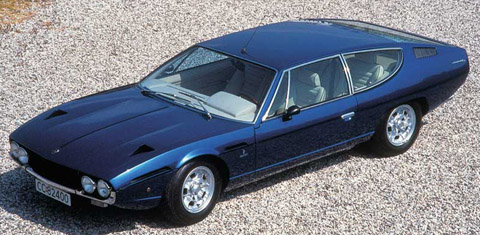
Lamborghini Espada, a True Four-Seater

Motoring enthusiasts marveled at the Lamborghini Espada when it was introduced in 1968 to fill the role of a true four-seater in the Lamborghini sports car stable. This grand tourer’s original fittings included a V12 engine of 4.0L 325 bhp (242 kW), four-wheel disc brakes and fully independent suspension. Its gearing is rather unusual at 3 ratios of drive, 1 and reverse. The Lamborghini Espada likewise was the introduction platform for the first automatic transmissions that could absorb a large sporting V12’s torque.
Lamborghini Espada
There were three series of Espadas that went into production. These are: the S1 series, which was manufactured from 1968 to 1970, the S2 from 1979 to 1972 and the S3 from 1972 to 1978. There were engine power improvements in each series, and dramatic alterations in the interiors. Only minor details were touched in the exteriors. For the S2, entirely new steering wheel and dashboard were installed, which were again redone in the S3. Optional power steering was offered in 1970, followed by an option automatic transmission offer in 1974. US safety standards required impact bumpers to be installed in the Lamborghini Espada in 1975, leading some people to believe that it is a S4 series although Lamborghini did not have such a design in mind. A total of 1217 Lamborghini Espada units were manufactured before it was phased out in 1978.

April 12, 2006 at 9:50 pm | No comment

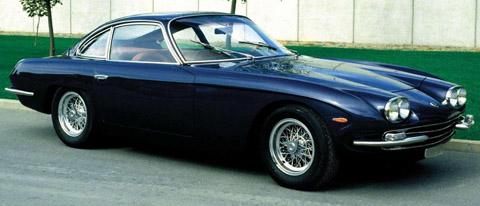
Growing With the Lamborghini 400GT

The Lamborghini 400GT is a follow-through of the successful launching of the first Lamborghini sports car, the 350GT. Motoring enthusiasts got their first glimpse of the Lamborghini 400GT in the 1966 Geneva show. This 2+2-seated sports car, compared to its predecessor, has increased power of 320 bhp (239 kW) coming from a larger engine of 3929 cc (240 c.i.). The Lamborghini 400GT also has a longer wheel base and larger body shape to accommodate two seats at the back of the car, in contrast to the 350GT which only has room enough for luggage or one seat at the rear. The two model’s roof lines were also markedly different as some sheet metal changes were made in the later model.
Lamborghini 400GT
The Lamborghini 400GT has a vastly improved drive-train after Porsche-style synchromesh was adopted in all its gears which incorporated a Lamborghini-designed gear box. There are several variations of the Lamborghini 400GT. Twenty-three of these smaller 400GT variants were manufactured sporting the four-liter V12 engine of the Lamborghini 350 GT, with three having aluminum bodies. There was also a one-off version of the Lamborghini 400GT called the 400GT Monza supposedly ordered as an American racing entry for Le Mans. All in all, 247 units of the Lamborghini 400GT were manufactured from 1966 to 1968, after which it was succeeded by the Lamborghini Islero.

April 12, 2006 at 9:04 pm | No comment

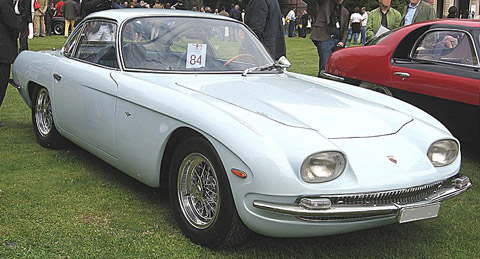
Lamborghini 350GT Arrives to Rival Ferrari

The Lamborghini 350 GT was the first production sports car to come out of the Lamborghini assembly line in Sant’Agata Bolognese, Italy, in 1963 to compete against the Italian sports carmaker Ferrari. Some talented engineers who were in Ferrari’s former employ were behind the development of the Lamborghini 350 GT, a grand tourer. Its quad-cam V12 engine was designed by Giotto Bizzarini, a former chief engineer at Ferrari. The power plant of the Lamborghini 350 GT has the capability to reach speed in triple digits at top form. This car has a top speed of 244.6 kilometers per hour (152 miles per hour), capable of accelerating from 0 to 60 mph in 6.8 seconds, and from 0 to 100 mph in 17 seconds.

Lamborghini 350 GT

Among this sports car’s other features are an aluminum body designed by Franco Scaglione who was also behind the classic designs of Alfa Romeo and Fiat car bodies. The Lamborghini 350 GT has four-wheel independent suspension, and the body was constructed with aluminum alloy panels fixed directly to a tubular frame. Side-mounted carburetors were installed for a more efficient engine heat reduction. One hundred forty-three Lamborghini 350 GT units were produced before it was replaced in 1966 by the Lamborghini 400 GT which has a larger engine.

April 12, 2006 at 8:32 pm | No comment

Aston Martin Pictures, Pics, Wallpapers, Photos & Images

Aston Martin was originally a British luxury cars and sports cars manufacturing plant, which was built in 1913 and is founded by Lionel Martin and Robert Bamford. Aston Martin Lagonda Limited is a producer of opulence operation cars, whose headquarters are at Gaydon, Warwickshire, England. The company is world-famous because of producing open-top wagon, the racing car and limited production sports car. Although Participating in the race course is important for the development of cars production, because of too much money and poor management, it is acquired by Ford of the United States in 1987.

[nggallery id=1 template=caption ]

February 11, 2006 at 5:31 am | 2 comments

->